



A mortgage payment can shape household finances for many years. Buyers therefore need more than an attractive interest rate or a preliminary loan estimate. They must understand how the purchase price, deposit, loan term, insurance, taxes, and other costs work together.
Homebuyer Mortgage Planning Florida buyers can use begins with a complete monthly housing budget. This budget should reflect ordinary living expenses, savings goals, and potential property maintenance. A lender’s maximum approval does not automatically represent a comfortable borrowing amount.
Online calculators can help buyers explore possible scenarios. However, their results depend entirely on the information entered. Missing taxes, insurance, association fees, or mortgage-related charges can create an unrealistic estimate.
A responsible plan combines calculator results with current guidance from qualified lending, insurance, tax, and real estate professionals. It also leaves room for unexpected expenses. This preparation helps buyers evaluate homes with greater confidence and avoid commitments that may strain future finances.
Understanding the Complete Monthly Housing Cost
Principal and interest form the basic mortgage payment. Principal reduces the loan balance, while interest represents the cost of borrowing. The relationship changes over the loan term. Early payments may contain a larger interest portion, depending on the loan structure.
Property taxes can add a significant amount to the monthly housing expense. Buyers should use current property-specific information when available. A previous owner’s tax bill may not represent the buyer’s future obligation. Ownership changes, exemptions, assessments, and local rules can affect the amount.
Homeowners insurance also requires early investigation. Premiums depend on property characteristics, location, coverage, deductibles, and current market conditions. Some properties may need additional coverage based on specific exposure. Buyers should obtain individualized estimates before making firm financial commitments.
Association fees may apply to condominiums and planned communities. These fees can support shared amenities, maintenance, reserves, and administration. Buyers should review what the fee includes and whether additional assessments are possible. A lower mortgage payment may still accompany substantial association obligations.
|
Cost Element |
What It Covers |
Planning Risk |
Recommended Action |
|
Principal |
Repayment of borrowed funds |
Underestimating loan size |
Compare purchase scenarios |
|
Interest |
Cost of borrowing |
Assuming rates remain unchanged |
Request current loan estimates |
|
Property taxes |
Local tax obligations |
Using a previous owner’s bill |
Seek property-specific guidance |
|
Insurance |
Property and liability protection |
Estimating without a quote |
Obtain current coverage options |
|
Association fees |
Shared community expenses |
Ignoring future assessments |
Review financial documents |
|
Maintenance |
Repairs and routine care |
Leaving no monthly reserve |
Build a realistic contingency |
Using Mortgage Calculations Responsibly
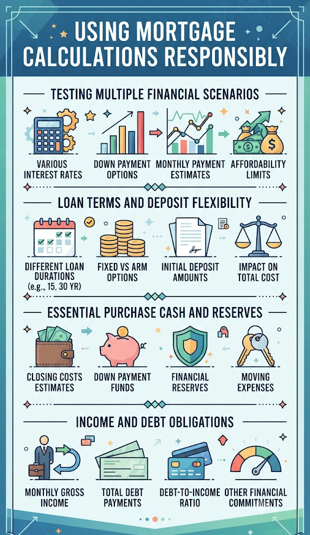
A mortgage calculator is a planning tool, not a loan commitment. It can show how different purchase prices, deposits, terms, and estimated rates affect payments. Buyers should test several possibilities rather than relying on one ideal scenario.
Test More Than One Financial Scenario
A conservative scenario can use a higher estimated rate and larger ownership costs. An expected scenario can reflect current professional estimates. A lower-cost scenario may illustrate favorable conditions. Comparing all three reveals how sensitive the budget is to change.
The deposit affects both the loan amount and the cash remaining after closing. A larger deposit may reduce monthly borrowing costs. However, using most available savings can leave limited reserves for repairs or emergencies. Buyers should balance payment reduction against financial flexibility.
Loan terms also change payment patterns. A shorter term may increase monthly payments while reducing total interest. A longer term may lower required payments but extend borrowing costs. The correct choice depends on income stability, long-term plans, and risk tolerance.
Useful calculator inputs include:
- Expected purchase price and available deposit
- Estimated interest rate and loan term
- Property taxes, insurance, and association charges
- Mortgage insurance or other loan-related costs
Separate Purchase Cash From Monthly Affordability
Buyers need enough cash for more than the deposit. Inspections, appraisals, lender charges, settlement expenses, insurance, and moving costs may require additional funds. Some expenses arise before closing. Others become part of the final transaction statement.
Emergency reserves should remain separate when possible. A new property can require immediate repairs, furnishings, utility deposits, or equipment replacement. Entering ownership without accessible savings can make ordinary problems financially disruptive.
Homebuyer Mortgage Planning Florida households undertake should also consider income changes. Seasonal work, variable commissions, retirement, or planned family changes may affect future affordability. A payment that fits current income may feel different later.
Debt obligations deserve the same attention. Vehicle payments, education loans, credit balances, and recurring commitments reduce available cash flow. Buyers should evaluate their complete financial position rather than viewing housing independently. A qualified financial professional can help interpret complex circumstances.
Comparing Comfortable Budgets With Maximum Approval
Mortgage approval evaluates whether a borrower meets a lender’s requirements. Personal affordability asks whether the payment fits the buyer’s preferred lifestyle and financial priorities. These questions overlap, but they are not identical.
Consider two buyers approved for the same loan amount. One has predictable expenses and substantial emergency savings. The other expects childcare costs and frequent travel. The same approved payment may create very different levels of financial pressure.
A comfortable budget leaves room for maintenance, savings, and ordinary changes. Maximum borrowing may reduce this flexibility. Buyers should decide which financial tradeoffs they are willing to accept before touring properties.
Comfortable Budget Versus Maximum Borrowing
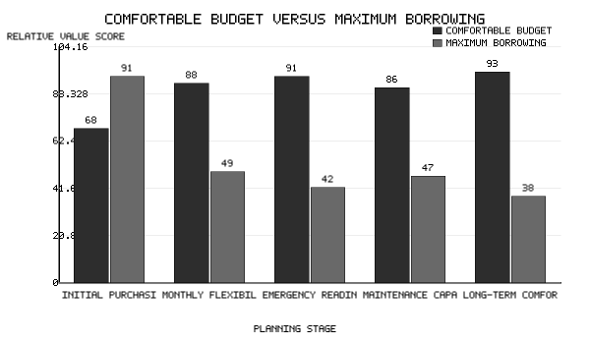
- Initial Purchasing: Maximum borrowing scores the highest at 91, significantly exceeding the comfortable budget score of 68.
- Monthly Flexibility: Comfortable budget jumps to 88, whereas maximum borrowing drops to 49.
- Emergency Readiness: Comfortable budget peaks tied for second highest at 91, while maximum borrowing falls to 42.
Creating a Step-by-Step Mortgage Plan
Begin by reviewing income, debts, savings, and normal household spending. Use several months of actual expenses instead of an idealized budget. This creates a more accurate picture of available cash flow. Irregular annual costs should be converted into monthly amounts.
Next, establish a preferred monthly range and a firm upper boundary. Include estimated taxes, insurance, association fees, and maintenance. The upper boundary should not depend on perfect conditions. A small contingency provides protection when costs change.
A practical planning sequence includes:
- Calculate current cash flow and establish an ownership reserve.
- Compare several purchase prices, rates, deposits, and loan terms.
- Obtain current professional estimates for major property expenses.
- Recalculate affordability before submitting a final offer.
Buyers should seek explanations for unfamiliar loan features. Adjustable rates, fees, points, prepayment terms, and mortgage insurance can affect the complete cost. Comparing annual percentages or monthly payments alone may miss important differences. Written loan estimates provide a stronger basis for review.
Property condition must remain connected with mortgage planning. A lower-priced home needing major repairs may require more available cash. A higher-priced property in better condition may have different insurance or maintenance needs. Inspections and insurance estimates can refine the calculation.
Finally, avoid moving funds or opening new credit without discussing possible lending effects. Financial changes during the transaction may influence approval. Buyers should maintain clear records and respond promptly to documentation requests.
Preparing for Sustainable Homeownership
Homebuyer Mortgage Planning Florida residents complete should support life after closing, not only loan approval. A sustainable plan includes the mortgage payment, ownership costs, reserves, and future priorities. This broader view reduces financial pressure.
Calculators provide useful starting points when buyers enter realistic assumptions. They cannot predict final taxes, insurance premiums, loan terms, or maintenance needs. Current professional estimates remain essential.
Buyers should compare several scenarios and update them as new information appears. Property documents, inspections, insurance quotes, and lender disclosures may change earlier calculations. Revising the plan protects decision quality.
Mortgage decisions can significantly influence long-term financial security. William Reynoso emphasizes careful budgeting, reliable information, and informed homeownership decisions. By consulting qualified lending, legal, tax, and insurance professionals, buyers can better understand their options and choose homes that meet their current needs while supporting future financial stability.